
Liposuction in Gangnam
Key takeaways
- Liposuction in Gangnam runs ₩3,000,000–₩8,000,000 ($2,300–$6,100) per single body zone (abdomen, flanks, thighs, arms) using PAL technique; multi-zone packages and VASER cases run higher (₩6–15M / $4,500–$11,500). Compare against US single-zone PAL typically running $4,000–$8,000 and full-circumferential ('360 lipo') $10,000–$20,000.
- Technique choice matters more than brand. Tumescent + PAL covers most body indications well. VASER ultrasound-assisted is preferred for fibrous areas (back, flanks, male chest, revision cases) and for surgeons aiming for high-definition contouring. Laser-assisted (SmartLipo, SlimLipo) is less common in Korean practice; reported skin-tightening claims are modest in published evidence.
- Korean clinics typically run smaller per-zone fat-removal volumes than Western practice — conservative-removal aims for refined contour rather than dramatic reduction. Total aspirate over 5L (large-volume liposuction; the ASPS/ASAPS threshold counts total aspirate including tumescent fluid, not pure fat alone) is generally avoided in single-day sessions for safety reasons (fluid shift, hemodynamic risk, lidocaine dosing); patients seeking large-volume removal are typically staged across multiple sessions.
- Recovery is longer than patients expect. Compression garments are worn 4–8 weeks; visible swelling resolves over 2–3 months; final contour and skin retraction are visible at 4–6 months. The 2-week post-op result is not the final result. Plan candidacy and timing accordingly.
What surprises most people
- Liposuction is not a weight-loss procedure. The aspirated fat reduces volume in the treated area but produces minimal change in body weight (5L of aspirate weighs about 4.5kg / 10lbs, much of it tumescent fluid that's removed during the procedure rather than fat). Patients seeking weight loss should pursue diet, exercise, or bariatric pathways; liposuction addresses contour for stable-weight patients.
- Korean conservative-removal philosophy is a feature, not a limitation. Western patient expectations sometimes calibrate to dramatic single-session volume removal. Korean surgeons more commonly take less in a single session and offer follow-up if more is wanted — this approach materially reduces complication rates (asymmetry, contour irregularity, skin laxity) and is associated with better long-term outcomes. Patients arriving with fixed expectations of dramatic single-session results sometimes need to recalibrate.
- Skin retraction is the limiting factor more often than fat volume. The patient's skin elasticity determines how well the surface contracts after fat is removed. Younger patients (under 40) with good elasticity retract well; older patients or patients with significant prior weight loss have less retraction and may end up with skin laxity after liposuction alone. The honest consultation will sometimes recommend skin-tightening procedures (abdominoplasty, brachioplasty, thigh lift) instead of or in addition to liposuction.
- VASER is meaningfully different from traditional liposuction in fibrous areas. The ultrasound emulsification step reduces the mechanical force needed during aspiration, lowering bruising and recovery time, and improving fat-removal efficiency in firm tissue (back, flanks, male chest, after prior procedures). For soft fat (lower abdomen, thighs in some patients), traditional tumescent + PAL produces similar outcomes at lower cost. Ask which technique is recommended and why.
- The harvest-reservoir is valuable for fat grafting in the same operation. Fat removed by liposuction can be processed and re-injected into face, breast, or buttock for volume restoration in the same session. This 'two-procedures, one anesthesia' integration is more common in Korean practice than in Western markets where surgeons often stage these. Patients with appropriate volume needs at multiple sites should ask explicitly whether integrated fat grafting is offered.
Liposuction — known clinically as suction-assisted lipectomy, in Korean as 지방흡입 — is one of the highest-volume body-contouring procedures in Korean cosmetic surgery and a meaningful share of Gangnam's surgical practice. The Korean clinical context shapes how the procedure is delivered here in three distinctive ways. First, Korean clinics typically run smaller per-zone fat-removal volumes than is common in Western markets — the conservative-removal philosophy aims for refined contour over dramatic volume reduction, with a lower threshold for follow-up sessions if more removal is wanted. Second, several Korean clinics have made VASER ultrasound-assisted technique a near-default for higher-end body work, especially for fibrous areas (back, flanks) and revision cases, with traditional tumescent and power-assisted (PAL) techniques covering most other indications. Third, fat grafting from the harvest reservoir is commonly offered in the same operation when the patient has appropriate volume needs in the face, breast, or buttock — this 'two-procedures, one anesthesia' integration is a meaningful efficiency vs. Western markets where surgeons often stage these.
The procedure addresses localized fat deposits that resist diet and exercise, body-contour refinement, asymmetry correction, lipedema (a specific medical indication), and the harvest side of fat-grafting procedures. The biological mechanism is mechanical fat-cell removal: cells aspirated through cannulas do not return, but remaining fat cells in the area can still expand if the patient gains weight. Liposuction is therefore best understood as a contour-refinement procedure for stable-weight patients, not a weight-loss tool.
Korean clinics handle the full range of body indications: abdomen and flank, thighs (inner, outer, anterior), arms, back, chin and neck, calves and ankles, and the harvest side of fat-grafting integrated with breast or facial procedures. The senior-surgeon case mix at established Gangnam practices runs into the high hundreds of cases annually for primary liposuction; surgeon volume genuinely matters for contour outcomes, asymmetry rates, and revision-surgery experience.
This guide covers what liposuction does in the Korean clinical context, the technique-type decision (tumescent vs PAL vs VASER), the per-zone considerations, what each indication realistically costs in Gangnam, the recovery arc from procedure day through 6-month settlement, candidacy assessment, and the questions that separate a thoughtful consultation from a high-volume operation. Fat grafting integration is referenced where relevant; full fat-grafting coverage lives in the dedicated fat-grafting guide.
What liposuction is (and is not)
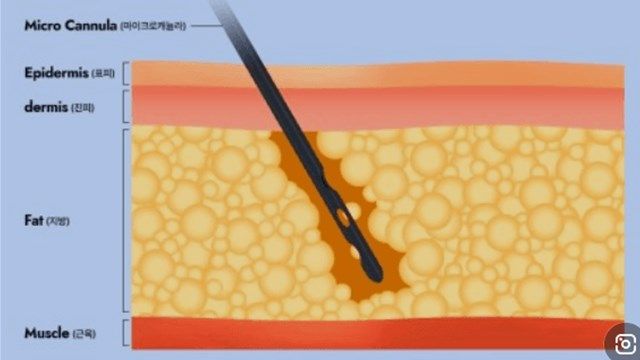
Liposuction removes localized fat deposits using small cannulas (typically 2–4mm) inserted through small incisions and connected to a vacuum source. The fat is mechanically aspirated; what remains is the underlying muscle and dermal layers, which contract over weeks to months to produce the final contour. The procedure addresses fat that resists diet and exercise — typically genetic deposits on the lower abdomen, flanks, outer thighs, inner thighs, arms, back, and chin/neck.
Technique categories in current Korean practice:
- Tumescent liposuction — the foundation technique. Tumescent fluid (saline + dilute lidocaine + epinephrine) is infiltrated into the target area before fat removal. The fluid softens fat, reduces bleeding, and provides local anesthesia. Used as the basis for all modern liposuction techniques below.
- Power-Assisted Liposuction (PAL, MicroAire) — the cannula vibrates rapidly, breaking up fat with less manual effort. Faster than traditional manual technique, lower surgeon fatigue, gentler on tissue. The most common Korean technique for soft-fat areas (lower abdomen, thighs, arms).
- VASER (Ultrasound-Assisted Liposuction) — ultrasound probe emulsifies fat before aspiration. Better for fibrous areas (back, flanks, male chest, after prior procedures), revision cases, and high-definition contouring. Higher cost; longer procedure time per zone.
- Laser-Assisted Liposuction (SmartLipo, SlimLipo) — laser energy melts fat before aspiration; some skin-tightening claims. Less common in Korean practice; published evidence for skin tightening is modest.
- Water-Jet Assisted Liposuction (Body-Jet) — pressurized water disrupts fat. Used in some Korean clinics; reported gentler on tissue but less penetrating than VASER for fibrous fat.
Body zones commonly addressed:
- Abdomen (upper, lower, full)
- Flanks (love handles)
- Back (bra-line, lower back)
- Thighs (inner, outer, anterior, posterior)
- Arms (upper)
- Chin and neck (submental)
- Calves and ankles (more challenging due to fibrous tissue and skin)
- Male chest (gynecomastia or pseudo-gynecomastia)
Liposuction is not the same as abdominoplasty (tummy tuck). Abdominoplasty removes excess skin and tightens fascia; liposuction removes fat. Patients with significant skin laxity or post-pregnancy fascial separation need abdominoplasty, with liposuction as an optional adjunct. Liposuction alone in significantly lax-skin patients produces incomplete results.
Liposuction is also not a weight-loss procedure. The aspirated fat reduces volume in the treated area but produces minimal body-weight change. Patients seeking weight loss should pursue diet, exercise, or bariatric pathways; liposuction addresses contour for stable-weight patients.
What patients actually report
Our reviews database holds a meaningful number of Korean-clinic body-contouring entries. Patterns below are aggregated from international forums (RealSelf liposuction boards, Reddit r/PlasticSurgery), Korean platforms, and peer-reviewed satisfaction literature.
Recovery duration is the most-underestimated part of the procedure. Patients judging their result at 2–4 weeks frequently describe it as too swollen, too firm, or insufficiently refined. Reviewers whose consultation explicitly walked through the 2-week-to-6-month timeline describe the experience as predictable; reviewers without that grounding describe weeks 4–12 as anxious or alarming.
Korean conservative-removal occasionally creates expectation mismatch. Patients arriving with US-calibrated expectations of dramatic single-session volume reduction sometimes describe their first-session result as 'less than expected.' Reviewers who understood the Korean staged-removal philosophy at consultation describe the same outcomes as appropriate; reviewers who pushed for larger single-session removal report higher rates of post-op asymmetry and contour irregularity.
Compression garment compliance is a meaningful satisfaction differentiator. Patients who wore compression garments as prescribed (typically 4–8 weeks) describe better skin retraction and contour outcomes; patients who removed garments early or wore them inconsistently describe more visible swelling and slower contour resolution.
VASER patients consistently report less bruising and faster recovery than traditional liposuction patients in fibrous areas. The technique difference is most visible in back, flank, and male chest cases. For soft-fat areas (lower abdomen, thighs in many patients), the difference is smaller and the cost premium may not be justified.
The filtered liposuction reviews show what we have today.
Cautions from clinical practice
Liposuction in trained Korean hands has a well-characterized complication profile. The publicly reported issues fall into surgical complications (bleeding, infection, anesthetic, fluid management) and contour-related issues (asymmetry, irregularity, skin laxity, residual fat).
Contour irregularity (waviness, lumpiness). The most common complication, reported in 5–15% of cases, varying by surgeon experience and technique. Caused by uneven fat removal, scar tissue, or post-op compression issues. Most resolve over 6–12 months as tissue settles; persistent cases may need revision (touch-up liposuction or fat grafting to smooth depressions).
Asymmetry. Reported in 2–8% of cases. The difference between sides develops over the recovery arc and is most visible at 3–6 months. Mild asymmetry is generally accepted; significant asymmetry requires revision.
Skin laxity. When fat is removed but skin doesn't retract enough, visible looseness develops. Reported in 5–15% of cases, with risk strongly age-dependent and prior-weight-history-dependent. Younger patients with good elasticity have low rates; older patients or significant-weight-loss-history patients have higher rates. Severe cases may require skin-removal surgery (abdominoplasty, thigh lift, brachioplasty).
Seroma. Fluid collection under the skin, reported in 5–15% of cases. Usually resolves with compression and time; persistent cases need needle aspiration or drain placement.
Hematoma. Acute postoperative bleeding under the skin, reported in 1–3% of cases. Severe cases require surgical drainage.
Infection. Reported rates under 2% with standard antibiotic prophylaxis; severe infection requiring readmission is rare (under 0.5%).
Numbness. Temporary numbness in the treated area is universal in the early recovery; permanent numbness occurs in 1–5% and is usually patchy rather than complete.
Residual fat / under-correction. Some areas may need touch-up procedures to achieve target contour. Reported revision rates run 5–20% across primary cases, varying widely by patient expectation and surgeon technique.
Pulmonary embolism / fat embolism. Rare but serious. Reported rates for liposuction-related pulmonary embolism are under 0.1% with standard anesthetic care, sequential compression devices, and ambulation protocols. Fat embolism syndrome (where fat enters circulation systemically) is rarer but more serious; risk increases with very large-volume liposuction (>5L aspirate) which is why most Korean clinics avoid this in single-session.
Lidocaine toxicity. The dilute lidocaine in tumescent fluid has a maximum safe dose; this is the practical upper limit on how much area can be treated in a single session. Anesthesia teams calculate this carefully. Importantly for medical tourists: lidocaine plasma levels typically peak 8–12 hours post-procedure due to slow absorption from tumescent fluid. Patients should not be alone in a hotel room during the first overnight period after substantial liposuction; a clinic-arranged caregiver, traveling companion, or hospital admission is appropriate. Toxicity symptoms include perioral numbness, tinnitus, lightheadedness, and (in severe cases) seizures or cardiac effects.
Death. Liposuction-related mortality varies meaningfully by case profile. Modern outpatient single-zone liposuction in healthy candidates trends toward 1:30,000 or lower in published series; combined procedures (tummy tuck + lipo + breast augmentation), large-volume liposuction, and cases in patients with pre-existing cardiovascular conditions push the risk meaningfully higher (toward 1:5,000 in older combined-procedure cohorts). Liposuction is the cosmetic surgery with the highest mortality risk, and the risk profile is non-trivial; the safety differential between single-zone and combined-procedure liposuction is one of the most important reasons not to bundle multiple major procedures into a single anesthesia event.
Technique choice — what Korean clinics actually do
Most Gangnam body clinics offer multiple techniques; the choice depends on the case. Some clinics market themselves as VASER specialists; others as PAL or general liposuction practices.
| Technique | Best fit for | Tradeoffs | Per-zone cost premium |
|---|---|---|---|
| Tumescent + PAL (MicroAire) | Soft-fat areas: lower abdomen, thighs, arms; primary cases | Standard technique; well-established; lower cost | Baseline |
| VASER ultrasound-assisted | Fibrous areas (back, flanks, male chest); revision cases; high-definition contouring | Better fat removal efficiency in firm tissue; less bruising; longer procedure time; higher cost | +30–60% over PAL |
| Laser-assisted (SmartLipo) | Small zones with skin-tightening goals (chin, small abdomen) | Skin-tightening claims modest in evidence; longer procedure time per volume; higher cost | +50–100% over PAL |
| Water-jet (Body-Jet) | Soft-fat areas; some Korean clinics | Gentler on tissue; less penetrating in fibrous fat | +20–40% over PAL |
| Traditional manual (suction only) | Rare in modern Korean practice | Higher surgeon fatigue; less consistent | −10–20% below PAL (rare) |
Many Korean clinics use a hybrid approach: VASER for the difficult areas (back, flanks, fibrous fat) and PAL for the softer areas in the same session. Ask whether the clinic uses pure PAL, pure VASER, or hybrid, and how they decide for a given case. The answer should reference fat firmness and skin retraction goals, not a one-size-fits-all preference.
The per-zone map
Liposuction addresses several distinct body zones; each has its own recovery profile, complication risk, and cost.
| Zone | Typical aspirate | Recovery profile | Notes |
|---|---|---|---|
| Lower abdomen | 1–3L | Standard | Most common single zone; pairs with abdominoplasty for skin-laxity cases |
| Full abdomen + flanks (360) | 3–6L | Longer; full compression for 6–8 weeks | Most popular Korean package; total volume limits apply |
| Outer thighs ('saddlebags') | 0.5–1.5L per side | Standard; longer compression | Common single-zone request; outer thigh fat is genetic and resistant to diet |
| Inner thighs | 0.5–1L per side | Standard; sensitive area | Skin laxity risk; honest consultation gates eligibility |
| Anterior thighs | 0.5–1.5L per side | Standard | Often combined with outer thighs |
| Arms (upper) | 0.5–1.5L per side | Standard; compression sleeves 4–6 weeks | Skin-laxity risk in older patients; brachioplasty alternative |
| Back (bra-line, lower) | 0.5–2L per area | Fibrous tissue; VASER often preferred | Difficult area; surgeon experience matters |
| Chin/neck (submental) | 50–200ml | Quick recovery; visible immediately | One of the highest-satisfaction zones; small volume; good outcomes |
| Calves/ankles | 0.3–0.8L per side | Fibrous tissue; longer compression | Most challenging zone; surgeon expertise required |
| Male chest (gynecomastia) | 0.3–1L per side | VASER often preferred | Combined with gland excision when needed |
Single-session aspirate totals over 5L (large-volume liposuction; the ASPS threshold counts total aspirate including tumescent fluid, not pure fat) are generally avoided in Korean clinics for safety reasons. Patients seeking high-total-volume removal are typically staged across two or three sessions over months.
Cost in Gangnam
Liposuction pricing in Korean clinics depends on technique, zone count, surgeon seniority, and whether fat grafting is integrated. The numbers below are clinic-quoted ranges as of 2026:
| Procedure | KRW range | USD range | Note |
|---|---|---|---|
| Single zone PAL (e.g., lower abdomen) | ₩3,000,000 – ₩5,000,000 | $2,300 – $3,800 | Mid-tier Korean PAL pricing |
| Single zone VASER | ₩4,500,000 – ₩7,000,000 | $3,400 – $5,300 | Premium for VASER technique |
| Abdomen + flanks (360 PAL) | ₩6,000,000 – ₩10,000,000 | $4,500 – $7,600 | Most popular package |
| Abdomen + flanks (360 VASER) | ₩8,000,000 – ₩13,000,000 | $6,100 – $9,900 | Premium tier |
| Multi-zone (abdomen + thighs + arms) | ₩10,000,000 – ₩15,000,000 | $7,600 – $11,500 | Volume discounts apply |
| Submental (chin/neck) only | ₩1,500,000 – ₩3,000,000 | $1,150 – $2,300 | Often single-session under sedation |
| Liposuction + fat grafting (face) | ₩5,000,000 – ₩9,000,000 | $3,800 – $6,800 | Integrated single-anesthesia case |
| Liposuction + fat grafting (breast) | ₩8,000,000 – ₩14,000,000 | $6,100 – $10,700 | Integrated; harvest from abdomen/thighs |
| Revision liposuction | ₩5,000,000 – ₩12,000,000 | $3,800 – $9,100 | Touch-up after asymmetry/contour issues; harder than primary |
For comparison: equivalent single-zone PAL liposuction in the US typically runs $4,000–$8,000 per zone; full-circumferential abdomen-flank ('360 lipo') $10,000–$20,000; UK £3,000–£6,000 per zone. The Korean tier sits meaningfully below US/UK pricing while offering technique sophistication and senior-surgeon involvement comparable to those markets. The trip math for liposuction is favorable for multi-zone or combined-procedure cases where absolute savings are large.
Recovery, day by day
Liposuction recovery is meaningful and structured. The procedure-day-to-final-result arc spans 4–6 months; the meaningful phases:
| Window | What you'll see | What you can do |
|---|---|---|
| Procedure day | General or sedation anesthesia recovery; compression garment placed; significant tumescent fluid drainage from incision sites for 24–48 hours; soreness | Stay in clinic 2–4 hours postoperatively; many discharged same day for single zone; overnight for larger cases |
| Day 1–3 | Significant swelling, bruising, soreness; continued tumescent fluid drainage; first dressing change | Limited activity; compression worn 24/7; first clinic check typically day 1–2 |
| Day 4–7 | Bruising at peak; swelling persistent; soreness improving; able to do desk work | Light desk work; gentle walking; compression worn 24/7 |
| Day 7–10 | Bruising fading; first clinic check; many patients flying home | Resume desk work; light walking; compression worn 24/7 |
| Week 2–4 | Bruising mostly gone; swelling significant but improving; treated areas feel firm and lumpy | Light cardio (walking, stationary bike); no upper-body strength training (if arms treated) or lower-body (if thighs treated) |
| Week 4–6 | Swelling halved; firmness softening; compression typically nighttime-only after week 4–6 (per surgeon) | Resume light strength training; no high-impact (running, jumping) yet |
| Month 2–3 | Visible swelling resolving; contour beginning to emerge | Full activity; full strength training; high-impact OK at month 3 typically |
| Month 4–6 | Final contour and skin retraction visible | Final cosmetic outcome assessment; revision discussion if applicable |
Trip duration: minimum 7-day stay (procedure + 5 days recovery + first clinic check before flying); optimal 10-day stay allows for two clinic checks and a more relaxed recovery. Compression garments are worn 4–8 weeks; patients flying home after 7 days continue compression at home.
The 10 questions to ask in your consultation
Suggested questions for your liposuction consultation. The technique choice, zone-by-zone planning, and surgeon-involvement questions are the highest-impact decisions.
- Which technique are you recommending and why? PAL vs VASER vs hybrid should be discussed with reference to your specific zones and fat firmness, not blanket clinic preference.
- What's the planned aspirate volume per zone, and what's the total? Total aspirate over 5L in single session is generally avoided; staged approaches should be discussed for larger goals.
- What's your cannula protocol per zone — size, depth (superficial vs deep), and direction? Cannula depth and approach conventions vary by zone and fat layer; superficial work tightens contour but increases skin-laxity risk if done aggressively.
- What's my realistic skin retraction at my age and skin elasticity? Honest answer references your tissue assessment and may recommend adjunct skin-tightening procedures or alternative approaches.
- Who specifically will be in the operating room, and what does the senior surgeon personally do during the case? Korean clinics vary widely in technician involvement; ask explicitly.
- What's your reported asymmetry and contour-irregularity rate? Specialist surgeons may have published or internal data; high-volume clinics may track outcomes.
- What's your protocol for asymmetry or contour issues if they develop? Touch-up timeline (typically 6+ months out), pricing, and approach should be discussed at primary consultation.
- Are you offering fat grafting integration in the same session? If you have appropriate volume needs at face/breast/buttock, ask about this; it's a meaningful efficiency.
- What's the all-in price including consultation, anesthesia, hospital fee, garment, post-op care, and follow-up? Get the full-stack number in writing; itemized line items reveal hidden costs.
- What happens if I'm dissatisfied at 4–6 months? What's the touch-up policy? Standard at premium Korean clinics is a discounted touch-up if results are meaningfully below expectation; clinics that don't address this question may be in marketing mode.
Choosing a clinic
Liposuction is offered by general plastic surgery clinics, body-contouring specialist clinics, and dedicated liposuction practices across Gangnam.
- Board-certified plastic surgeon with high body-contouring case volume — typically several hundred liposuction cases annually for premium-tier Korean practices.
- Documented technique and outcome protocols — pre-procedure markings, photography from standardized angles, aspirate volume documentation, post-op compression protocol, scar-management protocol.
- Dedicated revision experience — for revision candidates specifically; revision liposuction is meaningfully harder than primary and not all clinics handle it well.
- Anesthesia by board-certified anesthesiologist — not nurse-anesthetist or surgeon-administered, especially for multi-zone or large-volume cases under general anesthesia.
- Hospital-grade operating facilities — accredited; overnight observation if needed; emergency readiness.
- Modern technique availability — at minimum tumescent + PAL; ideally VASER capability for fibrous areas.
- Transparent zone-by-zone pricing — most Korean clinics quote per zone; beware all-inclusive flat prices that don't specify zone count or volumes.
- Fat grafting integration capability — for patients who want it; not all liposuction clinics offer this in the same session.
The filtered clinic directory shows current matches. For liposuction specifically, the dedicated body-contouring specialist subset is meaningful but smaller than the general plastic surgery clinic count; both can handle primary cases well.
Risks, complications, and what a safe clinic looks like
The published AE rates for primary liposuction in trained Korean hands sit roughly here: contour irregularity 5–15%; asymmetry 2–8%; skin laxity 5–15% (age-dependent); seroma 5–15%; hematoma 1–3%; infection under 2%; permanent numbness 1–5%; revision rate 5–20%; pulmonary embolism under 0.1%; mortality under 1:5,000 (lower in single-zone outpatient cases, higher in combined-procedure or large-volume cases).
Recognition. Patient-side signals worth knowing: sudden severe shortness of breath, chest pain, or oxygen drop in first week (potential pulmonary embolism — emergency); rapid one-sided enlargement in first 48 hours (potential hematoma); fever, redness, or unusual discharge from incision sites (potential infection); persistent fluid collection at week 3+ (potential seroma — needs aspiration).
Documentation. Pre-procedure photos from standardized angles in standardized lighting; weight and BMI; body-zone-specific measurements; aspirate volumes per zone; post-procedure photos at 1 week, 6 weeks, 3 months, 6 months. Clinics that maintain this protocol are operating in outcome-tracking mode.
Safety considerations specific to international medical tourism. The 7-day minimum stay is non-negotiable for multi-zone liposuction because the first clinic check at day 1–2 and the second at day 5–7 catch early issues that matter (drainage problems, infection signs, fluid collection). The compression garment fit is critical and often adjusted at the day 1–2 check. Patients flying home before day 7 should expect higher rates of recovery complications.
Who is a good candidate (and who is not)
Liposuction has well-defined candidacy. The ideal candidate is age 18+ in good general health, near or at goal weight (BMI under 30 generally; under 32 acceptable with case-specific assessment), with localized fat deposits resistant to diet and exercise, good skin elasticity for the planned removal, no active medical conditions that increase surgical or anesthetic risk, and realistic expectations grounded in the 4–6 month timeline.
Reasons to delay or skip:
- Significantly elevated BMI (over 32 generally). Liposuction is not a weight-loss procedure; higher BMI increases anesthetic risk, complication rates, and skin-laxity issues without solving the underlying weight question.
- Pregnancy or breastfeeding. Postpone liposuction until 6+ months after weaning; pregnancy changes body shape meaningfully.
- Significant skin laxity. Patients with substantial loose skin from prior weight loss or post-pregnancy fascial separation typically need skin-removal procedures (abdominoplasty, thigh lift, brachioplasty), not liposuction alone.
- Active or unstable medical conditions. Uncontrolled diabetes, cardiovascular disease, bleeding disorders, or other systemic conditions require evaluation and stabilization before elective liposuction.
- Unrealistic expectations. Patients seeking weight loss, dramatic single-session removal, or anatomic results that exceed what surgical technique can deliver are mismatched in expectation.
- Active smoking. Smoking impairs healing and increases complication rates; most surgeons require cessation 4–6 weeks pre and post procedure.
- Body dysmorphia / unstable body-image expectations. Repeated revision-seeking patterns or unstable expectations are red flags that warrant pre-surgical psychological assessment.
For older patients (over 50): skin elasticity declines with age; honest consultation may recommend skin-tightening adjuncts (abdominoplasty for abdomen, brachioplasty for arms, thigh lift for thighs) rather than liposuction alone.
When to travel and how long to stay
Liposuction requires a meaningfully longer stay than non-surgical procedures because the early recovery checkpoints matter and flying with significant swelling and compression is uncomfortable.
Minimum: 7 days. Procedure day, 5 days recovery (with first clinic check at day 1–2 and second at day 5–7), drainage stabilization, and clearance to fly. Tight but feasible for single-zone or two-zone cases.
Optimal: 10 days. Procedure + 8 days recovery + 2–3 clinic checks + drainage stabilization + a more relaxed recovery before flying. Most international patients choose this for multi-zone cases.
Long-arc follow-up: 3 and 6 month checks, typically managed via remote photo submission for international patients. Some clinics specifically schedule the 6-month follow-up for an in-person visit; this is recommended if any early-recovery concerns arose.
Combination trips: Liposuction generally should not be combined with other significant surgical procedures (rhinoplasty, breast augmentation) in the same trip due to cumulative recovery burden, anesthesia time, and lidocaine dosing limits. Combining with non-surgical procedures (botox, filler before lipo, light skin treatments after recovery) is reasonable but should be staged.
Touch-up sessions: If revision becomes needed (asymmetry, contour irregularity), typically scheduled 6+ months out. Most revisions require a second separate trip.
Tax refund, cash discount, and seasonal deals
Three layers of price reduction stack at most clinics. Liposuction is a high-absolute-amount procedure, so percentage savings translate to meaningful dollar savings:
VAT refund. Up to 10% of the procedure cost, recoverable at Incheon Airport for foreigners on tourist visas — but only at clinics registered with Korea's Medical Tourist Tax Refund program. Cosmetic liposuction generally qualifies; medical-coded cases (lipedema) sometimes don't. Either Global Tax Free or KT Tourism Tax Refund handles most refunds. The tax refund calculator shows what you'll actually recover after fees.
Cash discount. Typically 5–10%. On a ₩10,000,000 ($7,600) multi-zone case, this is ₩500,000–₩1,000,000 ($380–$760) in savings.
Seasonal promotions. Less common for liposuction than for non-surgical procedures, since clinical capacity and surgeon scheduling drive the calendar more than promotional cycles. Some clinics offer modest discounts for early-year scheduling or for combined procedures (liposuction + fat grafting bundles).
Currency exchange: Pricing in KRW is typically locked at booking. Patients booking 3–6 months ahead can occasionally benefit from favorable USD-to-KRW movement; the inverse risk is also real.
Alternatives to consider instead
Liposuction is the right answer for localized fat deposits in stable-weight patients with good skin elasticity. If your case is something else, consider these alternatives:
- Significant skin laxity. Abdominoplasty (tummy tuck), thigh lift, or brachioplasty (arm lift) address skin removal that liposuction can't. Often combined with liposuction in a single procedure.
- Generalized weight loss goals. Diet, exercise, or medical/bariatric pathways are appropriate. Liposuction is not a weight-loss tool.
- Mild cosmetic refinement. Non-surgical body-contouring devices (CoolSculpting, EMSculpt, ultrasound or laser-based fat reduction) produce modest results without surgery. Cumulative effect over multiple sessions is meaningful for the right candidate but won't match what liposuction can do.
- Cellulite-only concerns. Liposuction does not treat cellulite (which is a fibrous-band issue, not just fat); some patients with mild fat may see modest improvement, but cellulite-specific treatments (Cellfina, subcision, RF treatments) are more direct.
- Lipedema. A specific medical condition causing disproportionate fat deposition with characteristic patterns. Liposuction (typically water-jet or gentle PAL) can be helpful but should be performed by surgeons with explicit lipedema experience and as part of a broader medical management plan.
- Non-treatment. Some patients reassess after consultation and choose to live with their natural anatomy. This is a legitimate outcome.
A serious liposuction consultation will sometimes recommend weight loss first, skin-removal adjuncts, non-surgical alternatives, or non-treatment. That signals an outcome-focused practice rather than a high-volume operation.
The case for Gangnam for liposuction rests on three pillars. First, technique sophistication — VASER ultrasound-assisted, PAL, and hybrid approaches are widely available, with senior-surgeon involvement at premium-tier clinics. Second, fat-grafting integration — Korean clinics commonly offer combined liposuction-plus-fat-grafting in a single anesthesia event, which is a meaningful efficiency vs. Western markets where surgeons often stage these. Third, meaningful price differential vs. Western markets — a typical multi-zone case in Korea runs $4,500–$11,500 vs. $10,000–$20,000+ in the US for equivalent work, with absolute savings ($5,000–$10,000) that easily cover travel from any origin.
The case against is that liposuction is a recovery-intensive procedure with a 4–6 month settlement timeline and the same long-distance follow-up friction as other surgical procedures. Patients with elevated BMI or significant skin laxity may be genuinely poor candidates regardless of clinic; in those cases, no amount of technique sophistication substitutes for honest candidacy assessment. Patients seeking dramatic single-session results are likely to be disappointed by the Korean conservative-removal philosophy and should either recalibrate expectations or consider markets that match their preferred volume style (with the higher complication rates that often accompany aggressive removal).
The patients for whom Gangnam liposuction is most clearly the right call are those near or at goal weight with localized fat deposits; good skin elasticity for the planned removal; realistic expectations grounded in the 4–6 month timeline; willingness to accept the 7–10 day stay; and origins where flight cost is not prohibitive relative to the absolute savings vs. Western markets. The trip math is particularly favorable for multi-zone cases, combined liposuction-plus-fat-grafting cases, and revision-candidate patients seeking specialist Korean experience.
For revision candidates: revision liposuction is meaningfully harder than primary work, and not all Korean clinics handle it equally well. Specialist clinics with explicit revision experience exist; primary-focus clinics should be evaluated more carefully for revision indications.
If you do come, four practical notes. First, plan for the 10-day optimal stay rather than the 7-day minimum if your schedule allows; the second clinical check at day 5–7 and the more relaxed recovery materially reduce risk of early-detection issues. Second, get the technique, planned aspirate per zone, and total aspirate documented in writing before the procedure; this matters for any subsequent revision conversation. Third, plan for the 4–6 month settlement timeline mentally — the 2-week or 6-week result is not the final result. Fourth, the compression garment compliance question is part of the procedure outcome; clinics that downplay this are not optimizing for the patient's long-term result.
Liposuction is one of the K-beauty procedures where Korean conservative-removal philosophy materially shapes outcomes vs. Western markets, and where the technique-and-experience differential between premium-tier Korean clinics and lower-tier operations is large. The consultation conversation that matters most is the technique-and-zone planning conversation, not the pricing conversation. Korean surgeons typically engage substantively with this when given the opportunity, and the resulting outcomes for well-matched patients are competitive with any global market.