
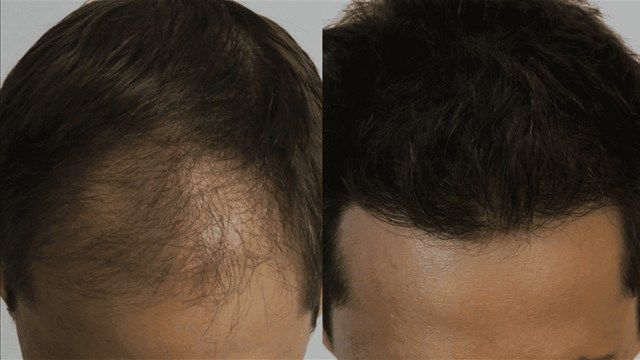
Haartransplantation

Surgical
Permanence
Transplanted follicles are permanent (donor-dominant); native non-transplanted hair continues to be susceptible to ongoing pattern loss
Downtime Days
1–3 days for visible recovery (small scabs in recipient zone); 7–10 days for scabs to fall off; full social recovery 10–14 days
Anesthesia
Local anesthesia with optional IV sedation; not general anesthesia for routine cases
Cost Range K R W
₩6,000,000 – ₩20,000,000 (typical 3,000–5,000 graft case)
Cost Range U S D
$4,500 – $15,000
Min Trip Days
4
Optimal Trip Days
7
Age Min
Generally 26+ for elective male pattern cases; younger candidates are often advised to stabilize on medication first to avoid chasing receding loss with repeated procedures

What might surprise you

  • Korea developed and refined the Choi implanter pen. The DHI technique using the Choi implanter was developed at Kyungpook National University in the late 1990s by Dr. Young-Chul Choi. The pen allows graft placement without separate channel-cutting steps and gives finer angle/direction control. It is more common in Korean clinics than in Western or Turkish markets and is a meaningful technique difference, not just a marketing label.
  • The 12–18 month timeline is not optional waiting. Patients who judge their result at 6 months and post negative reviews are judging a transplant before the regrowth phase has completed. The shedding phase at week 2–4 is biologically normal (the transplanted shaft falls out while the follicle stays in place); regrowth begins at month 3–4; partial density appears at 9–12 months; the final density verdict only forms at 12–18 months.
  • Megasession capability does not always mean megasessions are right for you. A 5,000-graft single-day session is operationally impressive but biologically demanding for the donor zone. A patient with thinner donor density may get a better long-term outcome from two staged sessions of 2,500 grafts each than from a single 5,000-graft megasession. Honest clinics customize session size to donor density, not to operational maximum.
  • Medication is part of how Korean surgeons frame the long-term outcome. Oral medications such as finasteride or dutasteride and topical minoxidil are commonly discussed at consultation as complementary therapy that can reduce ongoing native-hair loss in the transplant zone. Candidacy, dosing, side-effect risk, and contraindications must be evaluated by a prescribing physician during a private consultation, not based on third-party content. Korean clinics typically frame medication as complementary to transplant, not as a replacement.
  • Body-hair-to-scalp extraction extends donor capacity in advanced cases. For Norwood VI–VII patients with depleted scalp donor zones, beard or chest hair can be used to supplement scalp grafts. Beard hair has different texture and growth pattern than scalp hair, so it is typically used for crown coverage or density-padding rather than the hairline. Korean clinics with body-hair extraction capability are a meaningful subset, not all clinics.

Hair transplant — known clinically as FUE/DHI hair transplantation, in Korean as 모발이식 — is one of the highest-volume international medical-tourism procedures in Korea. Korean clinics now perform an estimated several tens of thousands of cases annually, with international patient share concentrated in clinics around Apgujeong and Sinsa-dong. The Korean clinical context shapes how the procedure is delivered here in three distinctive ways. First, DHI with the Choi implanter pen is genuinely Korean — the implanter pen technique was developed at Kyungpook National University in the late 1990s and remains more common in Korean clinics than in most Western or Turkish markets. Second, megasession capability (3,000–6,000 grafts in a single day) is widely available at higher-volume Korean specialist clinics, though biologically demanding for the donor zone in larger sessions. Third, the price tier sits between Turkey (low-cost, high-volume) and the US/UK (premium-priced) — meaningfully cheaper than Western markets while offering technique sophistication that the cheapest Turkish high-volume operations don't match.

The procedure itself addresses pattern hair loss (androgenetic alopecia), traction alopecia, scarring alopecia in stable phases, and cosmetic refinement of eyebrow and beard areas. The biological mechanism is donor-dominance: hair follicles taken from the genetically resistant donor zone (typically the back and sides of the scalp) retain their resistance to DHT-mediated miniaturization when transplanted to recipient zones, producing permanent regrowth in the new location. The two dominant techniques are FUE (extracting individual follicular units with a small punch, no linear scar) and DHI (extracting then implanting via the Choi pen without intermediate channel-cutting); each has Korean technique variations and clinic preferences.

Korean clinics handle both male and female cases, age-appropriate candidacy assessment, and the full set of cosmetic indications (scalp restoration, eyebrow restoration, beard restoration, body-hair-to-scalp transplantation in advanced cases). The senior-doctor case mix in dedicated hair clinics in Gangnam runs into the thousands annually for the higher-volume practices; experience and per-team density genuinely matter for graft survival rates.

This guide covers what hair transplant does in the Korean clinical context, the FUE-vs-DHI decision, what megasession capability really means, what each indication realistically costs in Gangnam, the long timeline from procedure day to final visible result, candidacy assessment, and the questions that separate a thoughtful consultation from a graft-mill experience. Botox and filler are referenced briefly under alternatives — they don't address hair loss but combine in the same Korea trip for many patients.

What hair transplant is (and is not)

Hair transplant moves genetically resistant hair follicles from the donor zone (typically the occipital and parietal scalp, sometimes beard or body hair in advanced cases) to recipient zones with pattern loss or absent hair. The transplanted follicles retain their genetic resistance to DHT — the hormone that drives androgenetic alopecia — and continue to grow in their new location for the patient's lifetime, barring graft trauma during the procedure or unrelated systemic disease.

Two dominant techniques in Korean practice:

  • FUE (Follicular Unit Extraction) — individual follicular units (typically 1–4 hairs each) are extracted from the donor zone using a small motorized or manual punch (typically 0.7–1.0mm). No linear scar; the donor zone retains a uniform short-hair appearance. Recipient zone preparation involves making channels with a custom blade before graft placement.
  • DHI (Direct Hair Implantation) — extracted FUE grafts are loaded into the Choi implanter pen, which creates the recipient channel and places the graft in a single motion. No separate channel-cutting step. Allows finer angle and direction control.

Older techniques you may encounter in archived materials but are uncommon in current Gangnam practice:

  • FUT (Follicular Unit Transplantation, strip method) — an elliptical strip of donor scalp is removed and dissected into individual grafts. Leaves a linear scar. Mostly superseded by FUE in Korean clinics for cosmetic reasons; some clinics still offer it for very-advanced-loss patients where strip excision yields more grafts in a single session.

Hair transplant is not a cure for ongoing pattern loss. The procedure relocates resistant follicles; it does not stop the underlying genetic process from continuing to thin native hair around the transplant zone. Patients who skip medication (finasteride, dutasteride, minoxidil) often see their transplant zone surrounded by progressing native loss within 5–10 years and require additional sessions. The transplant addresses the cosmetic deficit; medication addresses the ongoing process.

Hair transplant is also not a substitute for honest candidacy assessment. A young patient (under 26) with rapid recent loss is generally a poor candidate for elective transplant — the loss pattern hasn't stabilized, and chasing it with grafts produces a long sequence of unfortunate-looking interim states. A patient with very thin donor density relative to recipient demand cannot be cosmetically transformed by transplant alone regardless of surgical skill. The right answer in those cases is medication, time, and re-evaluation, not procedure.

What patients actually report

Our reviews database holds limited Korean-clinic hair-transplant entries directly tied to procedure-specific tagging — most hair-transplant reviews aggregate at the clinic level. Patterns below are aggregated from international forums (RealSelf, Reddit r/HairTransplants, BaldTruthForum), Korean platforms, and peer-reviewed satisfaction literature on FUE/DHI outcomes.

The shedding phase at week 2–4 is the most-reported anxiety trigger. Patients who arrived without understanding that transplanted hair shafts fall out while the follicle stays in place describe weeks 2–4 as alarming and are sometimes convinced the procedure has failed. Patients whose pre-procedure consultation explicitly walked through the timeline (procedure day → scab phase 1–10 days → shedding 2–4 weeks → dormant phase 4–12 weeks → regrowth begins month 3–4 → density at 9–12 months → final at 12–18 months) describe the experience as predictable. Pre-procedure expectation-setting is the strongest single predictor of mid-procedure satisfaction.

DHI patients consistently note the angle and direction precision at hairline reconstruction. Reviewers comparing DHI hairline work to prior FUE-channel work in the same patient or in side-by-side cohorts describe finer angle control with the Choi implanter. The cosmetic difference is most visible at the temple corners and the front-most hairline row, where dense angular consistency reads as natural vs. transplanted.

Korean megasession patients report long procedure days but generally favorable post-procedure recovery. A 5,000-graft single-day session typically runs 8–10 hours of total procedure time with multiple breaks. Patients who knew this in advance describe the day as manageable; patients who underestimated the duration describe it as exhausting. Recovery does not appear meaningfully worse than a 2,500-graft session in published cohorts, but the donor zone trauma scales with graft count.

Female-pattern-loss patients have more variable satisfaction. Female pattern hair loss generally produces diffuse thinning rather than the distinct hairline-recession-and-crown-thinning pattern of male androgenetic alopecia. The donor zone is typically also affected by some level of diffuse thinning, reducing the high-density resistant zone that male patients usually have. Female candidates with stable, patterned (not diffuse) loss who go through careful candidacy assessment generally report good outcomes; female candidates with diffuse thinning often achieve more modest cosmetic improvement and report lower satisfaction.

The filtered hair transplant reviews show what we have today.

Cautions from clinical practice

Hair transplant in trained Korean hands has a well-characterized complication and outcome profile. The publicly reported issues are mostly outcome-related (graft survival, density expectations) rather than safety-related; serious medical complications are rare.

Graft failure / low survival. Even in best practice, not every transplanted follicle survives. Reported survival rates in trained-hand FUE/DHI cohorts run 85–95%; in poor-technique or poor-handling cases, survival can drop to 60–75%. Survival depends on extraction technique (punch trauma, angle), out-of-body time, holding-solution quality, and placement technique. Patients seeing very low survival at 12–18 months typically had multiple compounding technique issues, not a single dramatic failure.

Shock loss in surrounding native hair. Surgical trauma in the recipient zone can trigger temporary shedding of nearby native hair (telogen effluvium). Reported rates run 5–15% with full regrowth typically over 6–9 months. Shock loss can be cosmetically dramatic during the regrowth phase but generally resolves; permanent shock loss is rare and usually associated with transection (accidental cutting of existing follicles during extraction or channel-creation) or with very dense placement in actively-thinning zones.

Donor zone scarring (FUE). FUE leaves micro-scars at each extraction site (typically 0.7–1.0mm). When evenly distributed, the donor zone retains a uniform short-hair appearance. When over-harvested in a localized area, visible patchy thinning of the donor zone can appear permanently. Korean clinics with megasession capability sometimes over-harvest in single sessions; patients who chose a too-aggressive single-session graft count are most at risk.

Recipient zone scarring. Channel cuts heal with minimal cosmetic visibility in most cases. Cobblestone scarring (raised pinpoint scars at each graft site) can occur with overly large graft sizes or improper placement depth. Reported rates are under 1% in trained hands.

Direction or angle errors. Grafts placed at wrong angles produce a bristly or unnatural appearance, particularly at the hairline. The error is permanent unless corrected by repair surgery, which has its own complications. Junior or technician-driven graft placement is the most common cause; senior-surgeon-led teams with explicit angle protocols have substantially lower rates.

Infection. Reported rates are under 1% with standard antibiotic prophylaxis. Most reported cases involve patient noncompliance with post-procedure wound care.

Numbness in donor or recipient zone. Temporary numbness from local anesthetic and minor nerve disruption is common and resolves over weeks to months. Permanent numbness is rare.

FUE vs DHI — what Korean clinics actually do

Most Gangnam hair clinics offer both FUE and DHI; the choice depends on the case. Some clinics market themselves as DHI specialists; others as FUE specialists.

AspectFUE (manual or motorized)DHI (Choi implanter pen)
ExtractionSame — small punch, follicle by follicleSame — small punch, follicle by follicle
Recipient channelCreated with custom blade before graft placementCreated and graft placed simultaneously by Choi pen
Angle/direction precisionGood with experienced surgeonReportedly finer at hairline; pen mechanically constrains angle
Out-of-body timeLonger (extraction → storage → placement separate steps)Shorter (graft moves more directly from extraction to placement)
Procedure speedFaster overallSlower per graft
Suitable for very large sessionsYes — megasessions of 5,000+ grafts feasiblePossible but slower; some clinics cap DHI sessions lower
Suitable for non-shaved (partial-shave) casesDonor must be shaved for extractionSame — donor must be shaved
Per-graft cost in Gangnam₩2,000 – ₩4,000 typical₩3,000 – ₩5,000 typical
Best fit forLarge sessions, body-hair extraction, very-advanced lossHairline reconstruction, finer cosmetic refinement, smaller-to-medium sessions

Many Korean clinics use a hybrid approach: FUE for the bulk of graft placement, DHI for the front hairline rows where angle precision matters most. Ask whether the clinic uses pure DHI, pure FUE, or hybrid, and how they decide for a given case. The answer should reference angle/direction concerns at the hairline rather than a one-size-fits-all preference.

The per-zone map

Hair transplant addresses several distinct cosmetic indications. Understanding which zones you're addressing changes the graft count, technique choice, and pricing materially.

ZoneTypical graft countTechnique preferenceNotes
Hairline reconstruction (frontal)1,500 – 3,000DHI for angle precision, or hybridMost-requested zone; sets cosmetic credibility of result
Mid-scalp / temples1,000 – 2,500FUE or hybridOften combined with hairline in single session
Crown / vertex1,500 – 4,000FUE for volumeHigher density requirement; often staged with frontal
Full-coverage Norwood V–VI restoration4,000 – 6,000+FUE megasession or 2-stageMay require body-hair supplementation in advanced cases
Eyebrow restoration200 – 600DHI for angle precisionSpecialist sub-procedure; very different angle conventions
Beard restoration1,000 – 3,000FUE or DHILess common in Korean practice than scalp; some specialist clinics
Scar coverage (post-surgical or burn)200 – 1,500FUESpecialty indication; needs case-by-case feasibility assessment

Graft counts are case-dependent and vary by donor density, recipient surface area, and target visual density. The numbers above are typical ranges in Gangnam practice. A patient may need fewer grafts if their existing native hair is dense enough that the transplant only needs to reinforce; a patient may need more if the recipient zone is large and bare.

Cost in Gangnam

Hair transplant pricing in Korean clinics is relatively transparent compared to surgical procedures because per-graft pricing is the convention. The numbers below are clinic-quoted ranges as of 2026:

ItemKRW rangeUSD rangeNote
FUE per graft (manual)₩2,000 – ₩3,000$1.50 – $2.30Standard FUE technique
FUE per graft (motorized punch)₩2,500 – ₩4,000$1.90 – $3.00Faster extraction; small price premium
DHI per graft (Choi pen)₩3,000 – ₩5,000$2.30 – $3.80Choi implanter; angle precision premium
Hybrid FUE+DHI per graft₩3,000 – ₩4,500$2.30 – $3.40Bulk in FUE, hairline in DHI
Eyebrow restoration (full)₩2,000,000 – ₩6,000,000$1,500 – $4,500Specialty pricing; often quoted per case
3,000 graft case (mid-tier)₩6,000,000 – ₩12,000,000$4,500 – $9,000Typical Norwood III–IV restoration
5,000 graft case (mid-tier)₩10,000,000 – ₩20,000,000$7,600 – $15,000Megasession or 2-stage; Norwood IV–V
Robotic FUE (ARTAS)₩3,500 – ₩5,500 per graft$2.70 – $4.20Available at select clinics; not always more accurate than expert manual

For comparison: equivalent 3,000-graft FUE at premium-tier US metro clinics typically runs $15,000–$30,000; UK £10,000–£20,000; Turkey $2,000–$5,000 (lower-cost mid-market US clinics can run lower than the premium tier). The Korean tier sits meaningfully below US/UK pricing while offering technique sophistication and senior-surgeon involvement that the cheapest Turkish high-volume operations don't always match.

The trip math for hair transplant favors Korea more clearly than for many other K-beauty procedures because the absolute savings ($10,000–$20,000 vs Western markets) are large enough to easily cover travel even from distant origins.

Recovery, day by day

Hair transplant recovery is unusual among K-beauty procedures because the visible result trails the procedure by 12–18 months. The early recovery (procedure day to day 14) is straightforward; the long arc to final result requires patience.

WindowWhat you'll seeWhat you can do
Procedure dayFull anesthesia of donor and recipient zones; small grafts visible in recipient zone with light bleeding; donor zone with extraction sitesDischarge same day; sleep semi-upright first night to reduce swelling
Day 1–3Crusting at recipient zone; mild swelling of forehead (gravitational); mild discomfort in donor zoneStay in hotel; shower carefully avoiding direct water on grafts; first clinic checkup typically day 1 or 2
Day 4–10Scabs in recipient zone; donor zone healing; swelling resolvingLight activities; no exercise; no swimming; no hats or hair coverings until clinic clears
Day 10–14Scabs falling off; recipient zone shows transplanted hair shaftsReturn to normal activities; avoid direct sun on healing zones; safe to fly home
Week 2–4 (shedding phase)Transplanted hair shafts fall out (this is biologically normal — follicles stay in place); recipient zone may look bare againNormal life; most anxiety-inducing phase if not pre-explained
Month 1–3 (dormant phase)Quiet phase; follicles in resting state; no visible new growthNormal life; stay on prescribed medication if applicable
Month 3–4 (regrowth begins)Fine new hairs visible in recipient zoneNormal life; typical first "is this working" check
Month 6Partial density visible; result still developingSome patients feel result is too thin at this point; this is normal mid-arc
Month 9–12Substantial density; texture and color matchingProcedure looks largely complete to non-specialist eye
Month 12–18Final density and textureFinal outcome assessment; touch-up planning if needed

Trip duration: same-day procedure, but minimum 4-day stay recommended (procedure + 2 recovery days + first clinic checkup before flying). Optimal 7-day stay allows for the second clinic checkup at day 5–7 and a more relaxed recovery. Touch-up sessions, if needed, are scheduled 12–18 months out and typically require a second separate trip.

The 10 questions to ask in your consultation

Suggested questions for your hair transplant consultation. The donor capacity, technique split, and surgeon-vs-technician questions are the highest-impact decisions.

  1. What's my Norwood (or Ludwig for female) classification, and what's the realistic graft count given my donor density? The honest answer references both the recipient demand and the donor supply, not just the recipient demand.
  2. FUE, DHI, or hybrid for my case, and why? The reasoning should reference angle/direction concerns at the hairline, donor zone characteristics, and total graft count — not a one-size-fits-all preference.
  3. Who specifically extracts, who specifically places? What's the surgeon-vs-technician split? Some Korean clinics have technicians do most extraction and placement under surgeon supervision; others have surgeons do extraction and angle-critical placement personally. Both models exist; ask explicitly which applies to your case.
  4. Single megasession or staged across two sessions? Donor density, total graft count, and expected outcome all factor in. The honest answer sometimes recommends staging.
  5. What's your protocol for graft handling and out-of-body time? Hair holding solution (HypoThermosol, ATP-enhanced solutions, or basic saline), holding temperature, and time-out-of-body all affect survival. Specialist clinics will describe their protocol; generic clinics often won't.
  6. What's your published or measured graft survival rate at 12 months? Specialist clinics with research backgrounds may have published data; high-volume clinics may have internal tracking. Vague "95%+" claims without methodology are sales statements, not data.
  7. Do you recommend finasteride or dutasteride for me, and what's your medication discussion approach? The answer should reference candidacy for medication based on your age, loss pattern, and contraindications — not a blanket yes-or-no.
  8. What's your touch-up policy if survival is below expectation at 12–18 months? Standard at premium Korean clinics is a discounted or supplementary touch-up if survival is meaningfully below expected; clinics that don't address this question are not addressing the extended-timeline nature of the procedure.
  9. What happens if I'm dissatisfied at 12–18 months? Most cases of dissatisfaction at the final timeline are unrealistic-expectation cases that consultation should have caught earlier. The clinic's framing of this question reveals how much they manage expectations vs. just selling the case.
  10. What's the all-in price including consultation, post-procedure care, follow-up visits, and any prescribed medication for the first year? Get the full-stack number, not just the per-graft price.

Choosing a clinic

Hair transplant in Gangnam is offered by both general plastic surgery clinics and dedicated hair-only clinics. The dedicated specialist model is more common at the higher-volume Korean practices.

  • Dedicated hair clinics typically have more consistent protocols, larger technician teams, and more megasession experience. Lower per-team variance in outcome.
  • General plastic surgery clinics offering hair transplant vary widely. Some have a senior hair surgeon on staff with strong outcomes; others are running occasional cases with less specialized teams.
  • Surgeon credentials — board certification in dermatology or plastic surgery is the baseline; explicit hair-transplant fellowship or substantial published case series are stronger signals.
  • Megasession capability — relevant only if your case is large; ask whether they routinely run 5,000+ graft cases vs. occasionally do.
  • Documented graft survival data — clinics that track outcomes show research orientation. Clinics that resist the question are operating in marketing mode rather than outcome mode.
  • Transparent pricing per graft — most Korean clinics quote per graft. Beware all-inclusive flat prices that don't specify graft count expectations.

The filtered clinic directory shows current matches. For hair transplant specifically, the shortlist is meaningfully narrower than for general K-beauty because the dedicated-specialist clinic count is smaller.

Risks, complications, and what a safe clinic looks like

The published AE rates for FUE/DHI hair transplant in trained Korean hands sit roughly here: graft survival 85–95% (well-established trained hands; lower in poor-handling clinics); shock loss 5–15% (resolves over 6–9 months in most cases); permanent shock loss under 2%; donor zone scarring (visible) 1–5% with appropriate distribution; recipient zone scarring (cobblestone) under 1%; infection under 1%; permanent numbness under 1%; angle/direction errors highly clinic-dependent.

Recognition. The mid-procedure complications worth recognizing: persistent severe pain in donor zone beyond day 3 (potential infection); pus or unusual discharge from any extraction site (infection); rapid expansion of swelling beyond day 3 (uncommon; rule out hematoma); unusually low scab count in recipient zone at day 10 (potential graft loss). Long-arc dissatisfaction signals worth recognizing: very thin density at month 12 (possible low survival), bristly or wrong-angle hairline at month 6+ (placement issue), donor zone showing patchy thinning at month 12 (over-harvest in single session).

Reversal and repair. Hair transplant is largely irreversible — once placed, grafts cannot be unplaced without trauma. Repair surgery exists for wrong-angle hairlines, over-harvested donor zones, and cobblestone scarring, but each repair has its own complications. The right time to catch issues is at consultation, not at month 12.

Documentation. Pre-procedure photos from multiple angles in standardized lighting; donor zone density measurement; Norwood/Ludwig classification; graft count plan with zone-by-zone breakdown. Clinics that maintain this protocol are operating in outcome-tracking mode; clinics that don't are not.

Who is a good candidate (and who is not)

Hair transplant has narrower candidacy than most K-beauty procedures because donor capacity, loss stability, and expected timeline all interact. The ideal candidate is age 26+ with stable or stabilized pattern loss (Norwood II–V for males, Ludwig I–II for females), sufficient donor density relative to recipient demand, realistic expectations grounded in the 12–18 month timeline, and willingness to consider medication as ongoing therapy.

Reasons to delay or skip:

  • Active rapid recent loss without stabilization. Patients in their early 20s with rapid progression in the past 1–2 years are typically advised to start medication and revisit candidacy at 1–2 years out. Transplanting actively-thinning zones produces ungainly interim cosmetic states and often requires repeated procedures.
  • Insufficient donor density relative to recipient demand. A patient with Norwood VI–VII loss and a thin or already-affected donor zone cannot be cosmetically transformed by transplant alone. The honest answer is sometimes "no" or "only modest improvement."
  • Diffuse rather than patterned loss. Diffuse thinning without a stable resistant donor zone is poor candidacy because the donor itself is at risk. This is more common in female pattern loss and in some male diffuse cases.
  • Active scalp disease or unstable medical conditions. Active alopecia areata is generally a contraindication for transplant — the underlying autoimmune process can attack transplanted follicles the same way it attacks native ones. Dermatology clearance, not just patient-reported stabilization, is the appropriate gate. Active scarring alopecia in unstabilized phase, severe uncontrolled diabetes, or other active autoimmune conditions affecting hair require equivalent specialist evaluation before transplant is considered.
  • Unrealistic expectations. Patients expecting "like before age 18" density from a stable Norwood IV pattern are mismatched in expectation; the procedure provides cosmetic improvement, not genetic reversal.

For female patients: female pattern hair loss tends to be diffuse rather than patterned, and the donor zone is often itself affected. Female candidates with stable, patterned loss who go through detailed candidacy assessment can have good outcomes; female candidates with diffuse thinning typically achieve more modest improvement. Female candidates should also rule out treatable causes (hormonal, nutritional, thyroid, autoimmune) before electing transplant.

When to travel and how long to stay

Hair transplant requires a meaningfully longer stay than most K-beauty procedures because the post-procedure clinical follow-up timeline matters more.

Minimum: 4 days. Procedure day plus 2 recovery days plus the first clinic checkup before flying. Tight but feasible.

Optimal: 7 days. Procedure day, 5 recovery days, two clinic checkups (typically day 1–2 and day 5–7), more relaxed recovery, and time for the donor zone scabs to be stabilized before flying. Most international patients choose this.

Long-arc follow-up: Photos and clinical check at month 3, month 6, month 9, and month 12–18 are typical. Most clinics handle this via remote photo submission for international patients; in-person follow-up is not required unless the clinic specifically schedules it.

Touch-up sessions: If needed, scheduled 12–18 months out. Typically requires a separate trip. Plan for this contingency in financial planning even if it's not certain to be needed.

Combination trips: hair transplant combines reasonably with non-surgical procedures (botox, filler, skin treatments) in the same visit if the cosmetic procedures are scheduled in the days before the transplant rather than after (the post-transplant restriction on heavy activity, hot showers, and hair products complicates many other procedures). Combining with significant surgical procedures (rhinoplasty, face surgery) is generally not recommended because of the cumulative recovery burden.

Tax refund, cash discount, and seasonal deals

Three layers of price reduction stack at most clinics. Hair transplant is a high-absolute-amount procedure, so percentage savings translate to meaningful dollar savings:

VAT refund. Up to 10% of the procedure cost, recoverable at Incheon Airport for foreigners on tourist visas — but only at clinics registered with Korea's Medical Tourist Tax Refund program. Cosmetic hair transplant typically qualifies; medical-coded scarring or trauma cases sometimes don't. Either Global Tax Free or KT Tourism Tax Refund handles most refunds. The tax refund calculator shows what you'll actually recover after fees.

Cash discount. Typically 5–10%. On a ₩10,000,000 (USD ~$7,600) procedure, this is ₩500,000–₩1,000,000 ($380–$760) in savings.

Seasonal promotions. Less common for hair transplant than for cosmetic injection because hair transplant has lower seasonality. Some clinics offer per-graft discounts for early-year scheduling or for combined-procedure packages. Discounts are real but rarely as deep as the seasonal promotional pricing on injection-based procedures.

Currency exchange: Hair transplant pricing in KRW is typically locked at booking, not at procedure date. Patients booking 3–6 months ahead can occasionally benefit from favorable USD-to-KRW movement; the inverse risk is also real.

Alternatives to consider instead

Hair transplant is the right answer for stable, patterned loss with sufficient donor density. If your case is something else, consider these alternatives:

  • Active rapid loss without stabilization. Finasteride, dutasteride, minoxidil, low-level laser therapy, and platelet-rich plasma (PRP) injections all address ongoing loss. A medication-first stabilization period of 1–2 years is something Korean surgeons frequently recommend for younger patients, with candidacy and dosing handled by a prescribing physician.
  • Diffuse thinning without patterned loss. Medication, low-level laser, and PRP often produce more meaningful improvement than transplant in diffuse cases. Some Gangnam clinics offer scalp-injection packages combining these therapies.
  • Insufficient donor for desired density. Body-hair-to-scalp extraction (BHT) is available in some specialist Korean clinics but with limitations; the alternative is accepting a more modest cosmetic target or using a hair system (toupee or topper) for density supplementation.
  • Female-pattern diffuse loss. Topical and oral medication, hormonal evaluation, nutritional optimization, and sometimes scalp pigmentation are often better starting points than transplant.
  • Cosmetic improvement without surgery. Scalp micropigmentation (SMP) can simulate density visually without follicle relocation. Best for short-hair-style preferences; less suited for longer hair targets.
  • Non-treatment. Some patients reassess their relationship with their hair loss after starting a process and choose acceptance, possibly combined with style changes (shorter haircut, beard) that reframe the appearance. This is a legitimate outcome.

A serious hair transplant consultation will sometimes recommend medication first, body-hair-extraction supplementation, staging, or non-treatment. That signals an outcome-focused practice rather than a graft-volume conveyor.

The bottom line

The case for Gangnam for hair transplant is one of the strongest of any K-beauty procedure when measured in dollar savings vs. Western markets. A typical 3,000–5,000 graft case in Korea runs $4,500–$15,000 vs. $15,000–$30,000 in the US; the absolute savings (often $10,000+) cover travel from any origin and meaningfully reduce total cost even after accounting for the longer required stay. The technique sophistication — particularly the Choi implanter pen for DHI and the megasession capability — places Korean clinics in a tier above the cheapest Turkish high-volume operations while remaining materially cheaper than the US, UK, or Australian premium tier.

The case against is that hair transplant is an unusually extended-timeline procedure: the final result lands at 12–18 months, the long-distance follow-up adds friction even with remote photo submission, and any touch-up that becomes needed at month 12–18 typically requires a second trip. Patients who want fast resolution or who can't commit to the 1.5-year evaluation window may be better served by a local provider despite higher cost.

The patients for whom Gangnam hair transplant is most clearly the right call are those with stable, patterned loss in the Norwood III–V range; sufficient donor density to meet recipient demand without over-harvest; realistic expectations grounded in the long timeline; willingness to consider medication as ongoing complementary therapy; and origins where flight cost is not prohibitive relative to the $10,000+ in absolute savings vs. Western markets.

For patients with Norwood VI–VII advanced loss, the Korean specialist clinics that handle body-hair-extraction supplementation are a meaningful subset, not all clinics. Consultation should include explicit discussion of donor capacity vs. recipient demand and what realistic outcome looks like; honest clinics will sometimes recommend modest expectations or staged sessions rather than promising full restoration. For female patients with diffuse rather than patterned loss, the candidacy assessment is more nuanced, and medication-first approaches often produce more meaningful improvement than transplant for diffuse cases.

If you do come, four practical notes. First, plan for the 7-day optimal stay rather than the 4-day minimum if your schedule allows; the second clinical check at day 5–7 is genuinely useful for catching early issues, and the more relaxed recovery is meaningful given the procedure intensity. Second, get the surgeon-vs-technician split in writing — the question of who personally does extraction and angle-critical placement is the single most-impactful clinical question. Third, plan for the 12–18 month timeline mentally and financially; touch-ups, if needed, require a second trip and additional cost. Fourth, the medication conversation is part of the procedure, not optional. Finasteride, dutasteride, or minoxidil discussion should happen at consultation; if the clinic skips it, that's a signal of a graft-volume orientation rather than an outcome orientation.

Hair transplant is one of the K-beauty procedures where the technique sophistication, the per-team experience, and the dollar economics align most clearly in Korea's favor. For the right candidate, the trip math is genuinely favorable; for the wrong candidate, no clinic and no trip can substitute for honest candidacy assessment. The consultation conversation that matters most is the candidacy conversation, not the pricing conversation.

Patientenbewertungen (1)

Von KI zusammengefasste Patientenberichte aus externen Foren. In der Originalsprache angezeigt; übersetzte Zusammenfassungen folgen in Kürze.

PurseForum Dana PS 2023-04-04
Vollständige Rezension lesen →